


For professional societies, the two most common reasons members don’t renew are an employer that stopped paying the dues (39 percent) and members who never engaged or used their benefits (38 percent). Price is well down the list at 28%. One more reason deserves attention because it’s pure waste: 24 percent of societies say members simply forgot to renew. Almost none of this is about members deciding the society isn’t a good resource. It’s about value that was never felt, budget decisions made over the member’s head, and renewal processes that leak.
The numbers in this piece come from the two best datasets in the field, read together: Marketing General Incorporated’s 2026 Membership Marketing Benchmarking Report, which surveys association executives, and Higher Logic’s 2025 Association Member Experience Report, which surveys members themselves. Where we cite MGI, we use their figures for individual membership organizations and their term for associations where professionals join as individuals, because that’s what a medical or professional society is, and those numbers differ sharply from associations overall.
Professional societies are having a harder year than “associations” are
Read a headline about association membership and you’re usually reading a blended number that mixes professional societies with trade associations, where entire companies join. The blend hides how different the two worlds are right now.
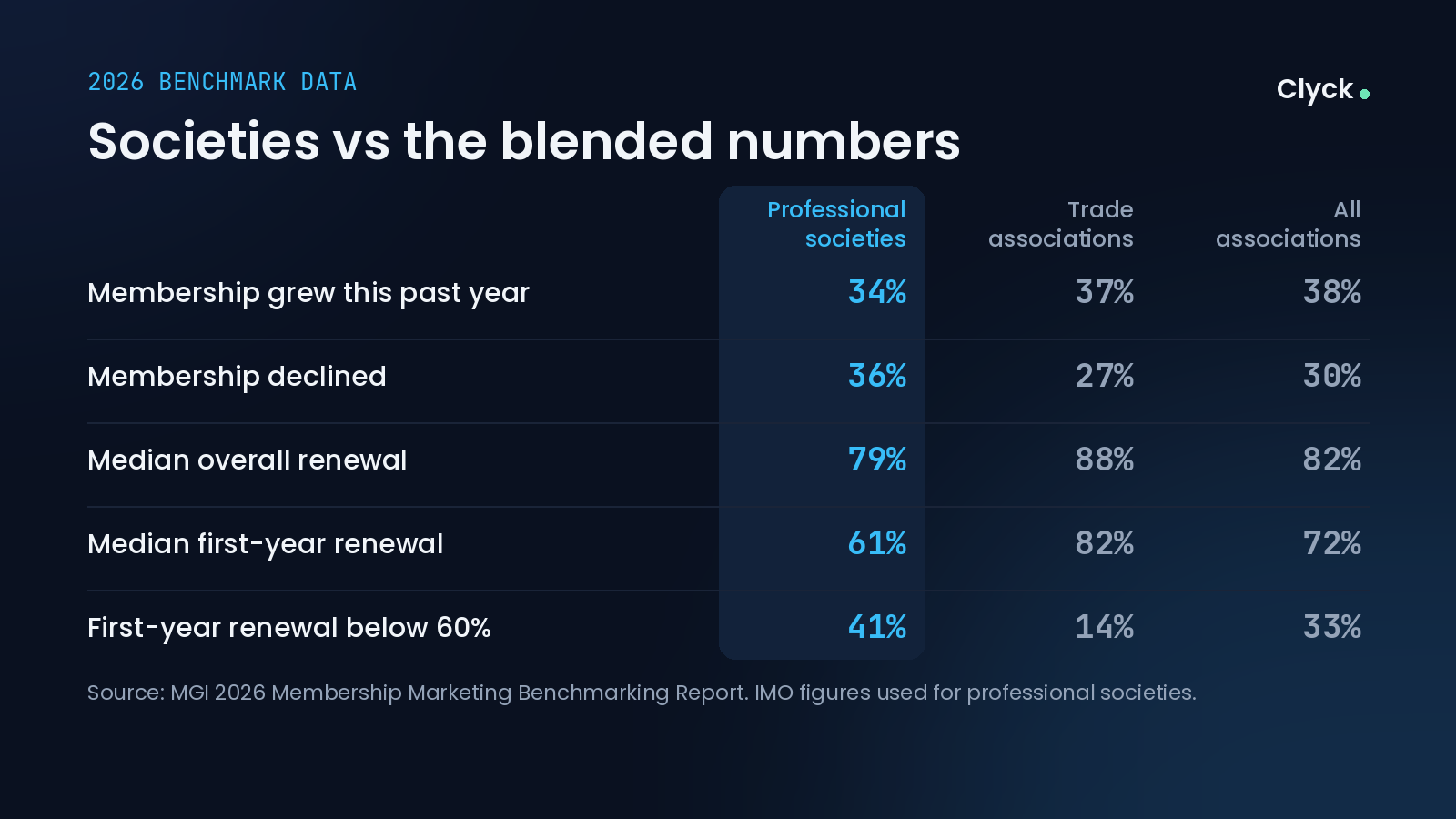
Professional societies are the only association type where more organizations declined
than grew this year, and the drop was steep: 49 percent were growing a year ago, 34 percent are now. Their first-year renewal is 21 points below trade associations’. When a society executive director feels like the environment got harder, the data agrees, and the blended industry numbers understate it.
The details help explain this gap. A trade association’s member is a company; the membership survives job changes and gets renewed by accounts payable. A society’s member is a person making an individual decision every year, often with their own money or a shrinking employer allowance. Every renewal has to be re-earned, which is why everything below is about the individual member’s experience of value.
Why members really leave, and why it’s rarely the price
What society executives cite as the top reasons members don’t renew:

Two things stand out. Price sits fifth, and the top two reasons describe different problems that need different fixes. One is a budget decision made by someone who isn’t the member, while the other is a member who paid and then never felt value for what they paid for.
The engagement reason has held near the top of this list year over year, and the survey’s wording matters: lack of engagement with the organization, or do not use benefits. A member who doesn’t use what they paid for accumulates no evidence to weigh against the invoice. Whatever reason they give on the way out, the real story is usually that nothing happened all year.
When the employer stops paying
This is the top-cited reason societies lose members, and most retention advice writes it off because it isn’t a marketing problem in the usual sense. The dues were a line in someone else’s budget, and the line got cut.
It’s specifically a professional-society problem. Twenty-six percent of association executives report employers unwilling to cover dues, but the burden falls almost entirely on individual-membership and hybrid organizations (34 and 35 percent) versus trade associations at 7 percent. Members confirm it from their side: among former members in the member survey, discontinued employer funding was a top reason for leaving (19 percent), behind only career changes and lack of value.
A society can’t control a hospital system’s budget. It can control three things:
Make the case the member takes to their employer. When dues come out of a department budget, the member is your internal salesperson, and most societies send them empty-handed. A one-page employer justification, what the membership returns in CME, credentialing support, clinical updates, and network access, in terms a department head recognizes, is cheap to build and directly attacks the top reason for loss.
Make membership survive the employer. If the value proposition is framed entirely as a professional benefit the institution buys, the membership dies with the budget line. Framed as something that belongs to the member’s career, board prep, fellowship connections, the community that follows them between jobs, it has a reason to survive on personal spend. The dues structure should help: 44 percent of associations now offer hardship accommodations and about a quarter offer installment payments, which turn a canceled employer check into a bridgeable moment instead of a lapse.
Become unforgettable. Nearly a quarter of societies say members lapse because they forgot. That’s not always a value problem, it’s likely a process leak, and auto-renewal largely closes it. Fifty-eight percent of individual-membership organizations now offer automatic credit card renewal, and associations reporting higher renewal rates are more likely to offer electronic funds transfer renewal options.
The gap between value delivered and value felt
Only 45 percent of professional societies rate their own value proposition as compelling or very compelling, down from 56 percent a year ago. When the ones who rate themselves below that are asked what’s stopping them, the top answers are an inability to articulate their value (38 percent), inadequate staff capacity (32 percent), and not understanding what members and prospects need (30 percent).
The report’s authors are blunt about it: for many associations the fundamental challenge is not a lack of value but an inability to communicate it clearly, to prospective members, to lapsing members, and to their own boards. Their data backs it. Societies renew a median of 79 percent of members, so most people who join keep paying. The value exists but it just isn’t being seen.
Here’s what that looks like from one member’s side. Andrew Dillon, a former president of the Association for Information Science and Technology, wrote publicly in 2018 about letting several of his memberships lapse. He read each benefits list, asked whether he actually used any of it, and decided it wasn’t worth the price of admission. When he told one association the cost-benefit didn’t work, they thanked him and did nothing. A past president of a society in his own field ran an honest audit and came up short.
Members likely run that audit once a year, in the two minutes after the renewal email arrives. If nothing over the previous twelve months connected a benefit to a result they cared about, the audit fails even when the society delivered.
What societies believe about members, and what members say about themselves
Two annual studies survey the two halves of this problem, and they should absolutely be read together.
MGI surveys executives, and its questions are phrased as beliefs: what do you believe are the top reasons members don’t renew? Useful, but it’s staff perception of member behavior. Higher Logic surveys the members. Its 2025 report covered 440 current association members and 112 nonmembers, and what members say does not match what staff assume:
- 82 percent of members say they feel engaged with their association, up from 67 percent a year earlier
- 86 percent say membership positively affects their career, up from 73 percent
- 83 percent plan to stay a member at least five years, up from 74 percent
But it matters who answered the survey. Seventy-five percent of Higher Logic’s member respondents serve as volunteer leaders on committees or boards, 83 percent have been members three years or longer, and only 4 percent are in their first year. These respondents are the most engaged slice of any membership.
Now the staff side. Professional societies report the lowest active engagement of any association type: 37 percent say fewer than a quarter of their members are actively engaged, against 19 percent of trade associations.
Read carefully, the two reports aren’t contradicting each other. They’re measuring different groups of members. Staff look across the whole membership and see thin participation. The member survey mostly hears from committee and board volunteers, engaged almost by definition; even inside Higher Logic’s own data, 89 percent of volunteer leaders plan to stay five years against 64 percent of non-leaders. The member in the middle, the physician who reads the journal digest every week and never attends anything, is underrepresented in both. She registers as inactive in the AMS, and she barely appears in the industry’s member research either. She isn’t unhappy, she’s just invisible to both.
So the retention problem for most societies is less about members souring and more about visibility: a society can’t tell its quietly satisfied members from its quietly departing ones, because much of what members value produces no activity a database can record, and even the industry’s member research mostly hears from the members who are already visible.
Two caveats: Higher Logic surveys current members, so people who already left aren’t in the sample, which pushes those numbers up. Both publishers sell into this market, MGI as a membership marketing agency and Higher Logic as engagement software, so each has an interest in the shape of its findings. They’re the best data the field has, but they aren’t neutral and they don’t measure the same population.
Renewal is decided long before the notice goes out
Societies lose the most members in year one. Median first-year renewal for professional societies is 61 percent, against 79 percent overall, and 41 percent of societies renew fewer than 60 percent of first-year members. Nearly half the people who joined decide within a year not to stay.
Compare what happens in that first year. Seventy-four percent of societies send a welcome communication in the first week. Then: 31 percent offer a volunteer opportunity, 31 percent do pre-renewal engagement, 25 percent introduce the new member to a chapter or special interest group, 23 percent encourage attending a first event, 20 percent do a 30-day check-in, and 6 percent assign a mentor. Most societies cover the first week and then go mostly quiet until the annual meeting or renewal.
One executive in the benchmark survey’s open responses said it directly: many members do not experience a significant enough level of engagement or immersion within their first year to feel compelled to renew.
The associations holding first-year renewal above 80 percent are measurably more likely to do the unglamorous early things, especially getting the new member to one event. Early attendance is one of the clearest dividing lines in the data.
What a year-round approach to keeping value visible looks like
Growing associations aren’t doing anything exotic. Their most common moves in the past year: new membership benefits (42 percent), a new member onboarding program (28 percent), and a membership engagement program (19 percent). Associations with renewal increases are more likely to have launched onboarding in that window. Five things carry most of the weight.
Tie every benefit to an outcome, in the member’s words. Members join for networking with peers and leaders in their field (53 percent), continuing education (34 percent), and a sense of community and professional belonging (29 percent). Prospects who don’t join say the top reason is being unclear on membership benefits and ROI (46 percent). A benefits list is just an inventory of what you have; the member wants to know what those things do for them. This is the 38 percent articulation problem, and it’s fixable without changing one benefit: among associations doing member research, better articulation of their value proposition was the single most common change the research produced (53 percent).
Measure engagement in more than one dimension. Behavioral tracking alone misleads, because much of what members value produces no activity a database can record. Ten percent of associations track no engagement at all, and only 21 percent use any scoring system. Combine what you can observe with what members tell you. Only 31 percent of associations run member research annually, and the ones that do are more likely to be growing. The member survey adds the reason it pays: 84 percent of members say a personalized experience matters, and members who feel their experience is tailored report meaningfully higher engagement and renewal intent. You can’t personalize what you haven’t asked about.
Fund engagement and renewal like they matter. Marketing budgets across associations average recruitment 17 percent, awareness 13, renewal 13, engagement 12, reinstatement 3. Associations that increased their engagement budget are significantly more likely to hold renewal above 80 percent, and 30 percent of associations budget nothing at all for winning back lapsed members.
Act on the quiet ones early. Pull the members whose activity dropped and do something before renewal season. Societies’ most common re-engagement tactics are “we miss you” campaigns (45 percent), feedback requests (39 percent), and introductions to new benefits (35 percent), all reasonable, though 18 percent of associations have no re-engagement tactics at all. On renewals themselves, phone calls from staff, board, or chapter leaders correlate with higher renewal rates, and one executive reported that personal calls begun mid-year produced a surprising number of renewals.
Make the first year deliberate. The highest-leverage stretch is the one most societies leave empty after the welcome email. Get one useful thing to happen early: a first event, the 30-day check-in that four in five societies skip, an introduction to the chapter or special interest group that matches the member’s actual work. The societies with the strongest renewal rates are measurably more likely to do exactly these things.
None of this needs a bigger budget. Most of it is a communication rhythm plus a decision to look at data already sitting in the AMS.
One value message for everyone reaches no one
The membership base has shifted under the messaging. Among professional societies, Gen X is now the largest cohort at 30 percent, Millennials are 25 percent, Baby Boomers have fallen to 24 percent from 39 percent in 2017, and Gen Z holds 11 percent. Associations reporting growth skew more Millennial.
Societies are responding fast. The share with no strategy for younger members dropped from 20 percent to 2 percent in one year. Special pricing tiers for young professionals are up from 30 to 55 percent, professional development programs from 27 to 50, mentorship from 27 to 49. The associations with renewal above 80 percent are much more likely to offer development programs and social events built for younger members.
The point for the renewal problem: an early-career physician wants credibility, skills, and access to people ahead of her. A mid-career member wants influence and efficiency. A late-career member often wants to give back and shape the field. A single renewal email can’t speak to all three at once. One executive in the survey responses admitted their materials were stale and written for older generations.
Frequently asked questions
Why don’t members renew their professional society membership? The two most-cited reasons are employer non-payment of dues (39 percent) and lack of engagement or unused benefits (38 percent), with lack of value at 30 percent. Cost ranks fifth at 28 percent, and 24 percent of societies say members simply forgot to renew.
Is non-renewal usually about cost? No. Only 28 percent of professional societies cite expense among the top reasons, behind employer support, engagement, value, and members leaving the field. Price is the easiest reason for a member to give, but it isn’t the most common cause, and members who can see what they’d lose tend to find the money.
What can a society do when employers stop paying members’ dues? Three things. Arm the member with an employer-facing case for the dues in terms a budget owner recognizes. Frame and price membership so it can survive on personal spend, including hardship accommodations and installment options. And close the process leaks, since auto-renewal addresses the quarter of losses attributed to forgetting.
Are members actually unhappy with their associations? Mostly no, with a note about who gets surveyed. The 2025 member survey of 440 current members found 82 percent feel engaged and 83 percent plan to stay five years or more, though three-quarters of its respondents are volunteer leaders, the most engaged segment of any membership. Even its non-leader respondents show 64 percent five-year intent. The core problem isn’t dissatisfaction; it’s that societies can only observe behavioral engagement, so they can’t distinguish quietly satisfied members from quietly departing ones.
How bad is first-year retention at professional societies? Median first-year renewal is 61 percent, and 41 percent of societies renew fewer than 60 percent of first-year members. Trade associations, by contrast, hold a median of 82 percent, largely because their memberships are institutional rather than personal decisions.
When do members actually decide whether to renew? Across the year, not at the notice. The 18-point gap between societies’ overall renewal (79 percent median) and first-year renewal (61 percent) shows how much is settled by the first-year experience, and most societies go quiet after the welcome email.
How do you keep members engaged year-round? Track engagement beyond event attendance, since much of what members value produces no activity a database can record. Ask members directly and act on it, because associations doing annual research are more likely to grow. Fund engagement, build real first-year touchpoints, and reach out personally to members who go quiet before renewal season arrives.