


Professional societies renew a median of 61 percent of first-year members, against 79 percent of members overall. Most of that gap traces back to the first few months of membership rather than to anything that happens at renewal time. The members who leave after one year mostly are not rejecting the society. They joined, received a welcome email, and then heard nothing useful until the invoice arrived, and by then the decision was easy to make.
The evidence comes from both sides of the relationship: what societies do in a member’s first year, from Marketing General Incorporated’s 2026 Membership Marketing Benchmarking Report, and what members say they experienced, from Higher Logic’s 2025 Association Member Experience Report. Benchmark figures throughout use the individual membership organization segment, because an association where professionals join as individuals is what a medical or professional society is.
The first-year numbers societies are living with
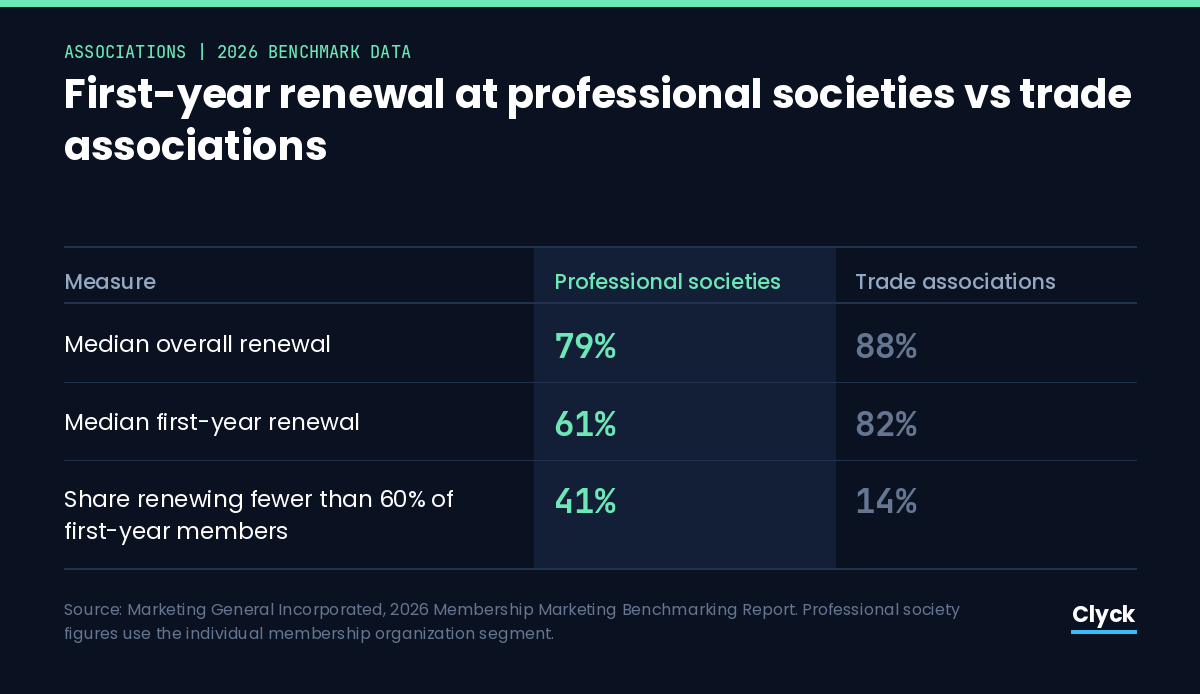
Two in five societies renew fewer than 60 percent of the people who joined in the past year. Losing that many first-year members costs more than renewal-season effort can recover, because a member who lapses in year one never reaches the later years where retention gets cheap. Members who stay past the first year mostly keep staying, which is why overall renewal holds near 79 percent. The first year sets most of what the retention numbers look like afterward.
Why you have probably seen different first-year numbers
Most retention guidance quotes first-year renewal around 75 percent against an overall rate near 84. Those figures are accurate, and they describe all associations blended together, which includes trade associations where companies join rather than individuals.
The two behave differently enough that the blend describes neither well. A trade membership renews inside a procurement process and survives the departure of whoever originally signed it. A society membership renews when one clinician decides it was worth her own money, or worth defending in a department budget. Every year, individually.
The size of the difference matters for planning. The blended figures suggest first-year members renew about nine points below everyone else. For professional societies the real gap is eighteen points, and it sits in the cohort where most of the losses happen. A society that benchmarks itself against the blended number will conclude it is doing worse than its peers when it is doing about average, or conclude it is fine when it is not.
Ease is the strongest predictor in the member data
The member survey asked how easy it was to get involved and find value as a new member, then compared outcomes between the members who said it was very easy and those who found it difficult.
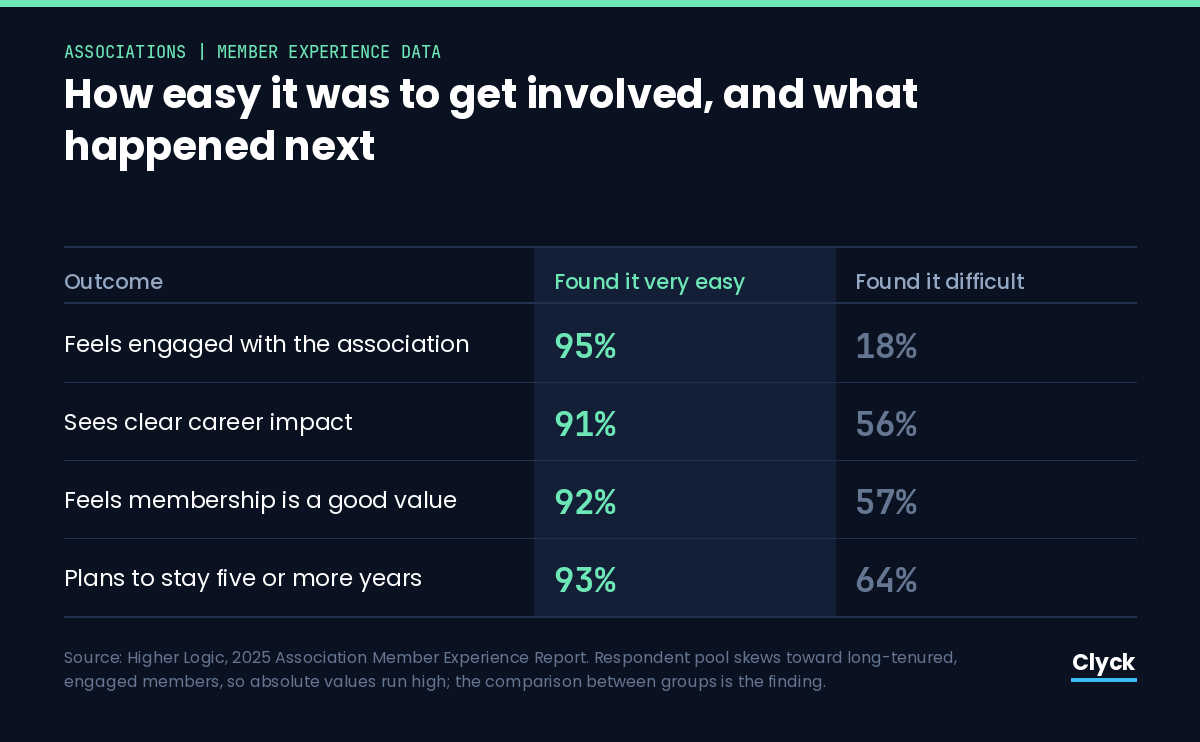
Onboarding quality sits underneath the ease. Among members who found involvement very easy, 98 percent said onboarding was clear and helpful. Among those who found it difficult, 27 percent did.
One fairness note. The member survey’s respondent pool skews toward long-tenured, highly engaged members, so the absolute numbers run high across the board. The comparison between the two groups is what matters here, and it is large. Members who worked out how to get involved stayed. Members who could not mostly stopped paying attention, even when they remained on the roster a while longer.
Ease here means something specific. The new member knew what to do first, could find the community or content that matched her work, and got some payoff from the membership quickly. Difficulty means she logged in once, saw a portal built for people who already knew their way around, and never came back.
What societies actually do in a member’s first year
Set the ease findings against what societies deliver, per the benchmark survey:
- 74 percent send a welcome communication in the first week
- 31 percent offer a volunteer opportunity
- 31 percent do pre-renewal engagement before the first renewal
- 25 percent introduce the new member to a chapter or special interest group
- 23 percent encourage attending a first event
- 20 percent do a 30-day check-in
- 6 percent assign a mentor or buddy
Almost everyone handles the first week. After that, the touchpoints most likely to get a member involved, meaning an introduction to the right group, a nudge toward one event, and a human check-in, are practiced by a quarter of societies or fewer. A year that consists of one welcome email followed by an invoice is the year that produces a 61 percent renewal rate.
The other end of the data points at the same touchpoints. Associations holding overall and first-year renewal above 80 percent are significantly more likely to encourage new members to attend an event, and early attendance is one of the clearest dividing lines between renewing and lapsing first-year members anywhere in the benchmark research.
A 90-day design a small staff can actually run
Nothing below requires new benefits, new software, or headcount. It requires treating the first 90 days as a program with an owner rather than a byproduct of the join form.
Days 1 to 7: one welcome, one action. Keep the welcome email, and give it a single job, which is getting the member to do one thing rather than read twelve links. The strongest candidates are joining the interest group or section that matches her work, or registering for the next accessible event, and virtual counts. A welcome that asks for one action gets more members started than one that lists every benefit.
Days 8 to 30: one introduction, one question. Connect the member to the smallest relevant unit of the society, whether that is her subspecialty section, a committee, a chapter, or an online community space, based on what she told you at join. Only a quarter of societies do this, and it produces exactly the experience the ease data rewards: finding the people who do what she does. Then close the month with the 30-day check-in that four in five societies skip. One human email or call, asking what she joined hoping to get and whether she has found it yet. The answers are more useful than anything in the AMS.
Days 31 to 90: one event and one quick win. Push toward a single attended event inside the first quarter, because attendance is the dividing line the renewal data keeps pointing at. Pair it with something concrete she can use right away, such as the CME tracker set up, a credential pathway mapped, or one clinical resource that applies to her actual practice. Value she got early is value she can remember at renewal.
Throughout: close the leaks. Offer auto-renewal at the join itself, while attention is high. Fifty-eight percent of individual-membership societies now offer automatic credit card renewal, and a quarter of societies report losing members to simple forgetting. Track four signals across the 90 days: welcome-email click, group join, event registration, and check-in response. Checked at day 90, they identify the members drifting away months before the renewal report would.
The measure the board wants to know
Run one report: renewal rate of members who attended at least one thing in their first 90 days, against members who attended nothing.
The benchmark data indicates what you will find, since early attendance separates renewing from lapsing first-year members across the research. What your own report adds is your own number, and a first-90-days program backed by your own renewal data is easier to defend to a board than one backed by industry averages.
Frequently asked questions
Why do so many first-year members fail to renew? Because the renewal decision reflects the first-year experience, and at most societies that experience is one welcome email followed by months of nothing. Median first-year renewal at professional societies is 61 percent, and the touchpoints most associated with retention, meaning an early event, a group introduction, and a 30-day check-in, are practiced by a quarter of societies or fewer.
What is the most important thing to do in a new member’s first 90 days? Get them to one event and into the one group that matches their work. Early attendance is among the clearest dividing lines between first-year members who renew and those who lapse, and members who found it easy to get involved report far higher engagement and five-year intent than those who found it difficult.
How long should new member onboarding last? Treat 90 days as the program rather than the first week. Nearly three-quarters of societies handle week one; the drop-off afterward is where the 18-point gap between first-year renewal (61 percent) and overall renewal (79 percent) comes from.
Why do some sources say first-year renewal is 75 percent? Because that figure blends professional societies with trade associations, where companies join instead of individuals and memberships renew through a procurement process. For individual membership organizations specifically, median first-year renewal is 61 percent against 82 percent at trade associations.
How do you know if a first-year member is at risk? Watch four signals by day 90: whether they acted on the welcome, joined a group, registered for anything, and responded to a check-in. A member dark on all four is likely to lapse, and at day 90 there is still time to change that.
Does onboarding matter more than the benefits themselves? The data does not separate them cleanly, but it does show that members who could not find their way to the benefits rated the membership poorly regardless of what it contained. Value that a member never located does not count toward the renewal decision.
Can a small membership team run a 90-day program? Yes, and the touchpoints that correlate most with retention are the cheap ones. A single welcome action, one group introduction, one check-in email, and a nudge toward one event require staff attention rather than budget or new software.